During our daily life, we came across many sensations. The sensation or feeling of touch is the one we encounter mostly and very clearly. This sensation helps us recognize the texture (rough or smooth) of the material we are touching immediately and after that our brain tells us the type of material based on its stored sensation vocabulary. This judgement about material perception is called “Shitsukan” In Japan, “which means that how human brains make sense of material quality. Shitsukan (質感) is a Japanese word whose literal meaning is the sense (kan, 感) of quality (shitsu, 質), and it is commonly used to cover the wide range of topics to which material perception in a broad sense is assigned.
The material quality, mean the properties of materials, such as whether they are gloss or matt; wet or dusty; metal or ceramic and so on”. This science or this behavior of human brain can be the basis of incorporation of artificial intelligence in textiles. This science can be applied to any material type however in this blog I would try to cover this topic with special focus on textile materials, so that my readers may have a basic knowledge of the relationship between science and textile materials.
Photo by fabrieka.com
As mentioned above Material perception, or Shitsukan perception, is about the perception and recognition of a material type, properties, surface quality such as glossiness, translucency and texture, or internal state of an object. This perception and recognition is based on sensory stimuli such as visual, tactile, and auditory sensations. The shitsukan is perceived via our five senses. For example from the surface of an object we touch, we can feel and tell which material is used to make it. Quite often during the buying of textiles in our daily lives we try to feel and decide weather the fabric is comfortable or not. This is called the qualitative judgement of the shitsukan of a fabric. In recent years, numerous studies have attempted to understand the perception mechanisms of shitsukan. To efficiently design shitsukan of a product it is important to quantify it, and studies have reported the methods of quantifying the perceived impression of materials in terms of, the appearance, touch and visual shitsukan.
Information obtained through material perception is associated with our actions toward an object. Because the physical processes leading to sensory signals related to material perception is very complicated, therefore is very difficult to create an experimental stimuli in an efficient way. However, that situation is now changing thanks to advances in technology and knowledge in related fields. In this blog, I will review what is currently known about the neural mechanisms that is responsible for material perception. It has been found that the cortical areas in the ventral visual pathway are strongly involved in material perception.
Therefore, in this blog my focus will be on vision. Surface quality and object appearance, as well as the feel of a finish or texture are also tightly related to one’s preference/aversion or emotional reaction toward an object. Despite material perception being biologically very important, the understanding of its hidden mechanism has not progressed very much. However, because of advancement in the fields of computer graphics and vision, the technology involved in the analysis and simulation of the interaction between light and object, it is now possible to generate and use stimuli simulating objects with various surface qualities.
Photo by fabrieka.com
What kind of information is involved in material perception?
The interaction of light with objects having specific surface meso-structures and optical properties produces various structures within the retinal images of objects, and these structures are the source of generation of a variety of surface qualities. In addition to this, other sensory modalities are also involved in material perception. For instance, when we see a sweater made of fine wool, we can perceive that it will be soft and warm, or we can sense that a metal cup will be cold and hard to the touch. Therefore, the information obtained through different sensory modalities is closely linked with each other in material perception. In this blog I will review cross-modal aspects of material perception including following.
Neural processing of surface qualities, particularly the glossiness that can be named as “GLOSSINESS PERCEPTION”.
Neural processing of surface meso-structures, that is another important property and is closely linked to material perception named as “NATURAL TEXTURE PERCEPTION”.
Neural processes involved in categorization of materials and recognition of various material properties, such as roughness and hardness, based on information about surface glossiness, natural textures, and so on. It can be called as “RECOGNITION OF MATERIAL CATEGORY AND ITS PROPERTIES”.
Now it is very difficult to cover all of the above modalities in one go therefore, I will elaborate all of the above modalities one by one in my next blogs.
Sources:
Komatsu H, Goda N. Neural mechanisms of material perception: Quest on Shitsukan. Neuroscience. 2018 Nov 10;392:329-47.
The ability of a material to recover its original shape and size after removal of strain which caused the deformation is known as resilience. Textile structures are visco-elastic in nature and due to this unique feature of visco-elasticity they are resilient and flexible. Unlike traditional engineering materials (TEMs), textile structures are highly resilient and they can spring back to their original state after being crushed or wrinkled. Resilience is also termed as memory. Resilience is a vivid characteristic of most textile structures and it can be expressed as:
Resilience can also be defined as a measure of elastic reversibility. The creep and relaxation properties of both textile fibers and fabrics are directly related to resilience. Primary creep that is recoverable deformation is a function of delayed elasticity which is also an important factor in resilience. While, the secondary creep that is permanent…
Corona Virus, now a days is the most scary thing every one is talking about. How it is spreading?, how to protect from it?, how to contain the spread of this virus? and Is there any cure or vaccine for it? These are the questions almost everyone is looking answers for. Being a Textile Engineer and having knowledge in the area of Medical Textiles as well as Non-woven fabrics, I thought I should give my readers a laymen knowledge about one of the protection methods, that is wearing a surgical mask. Now there are many different kinds of protective masks available, however the most common and most used one is the disposable surgical mask. So in this blog I will present surgical masks, their anatomy, function and properties according to protection levels. Because now a days everyone is looking for a mask consequently with a boost in demand, many fakes…
Wool and other hair fibers have the most complicated structures of all textile fibers. Wool is composed of a complex blend of proteins and other chemical substances. The thermal and mechanical responses of the fibers are determined by a variety of inter-atomic and inter-molecular bonds and a variety of structural forms. The wool fiber has a slightly and imperfectly elliptical cross section. In this blog, for my readers I intend to write briefly about the vital few advantages of wool fiber over other fibers.
Advantages of Wool Fiber
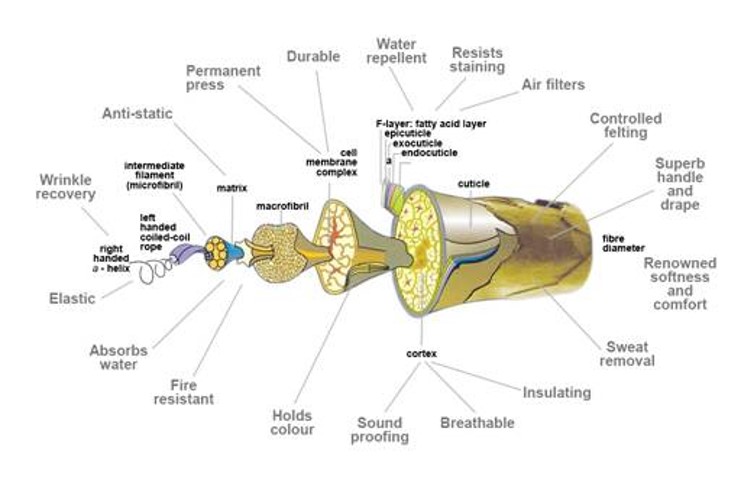
In addition to the particular tensile and other properties, the special features of structure of wool fiber are crimp, which leads to high bulk and softness, and scales, which lead to felting. Good recovery properties are also beneficial, and especially the regeneration of properties by washing. The structural elements of wool fiber and their specific role in terms of performance are shown in Figure.
The structural elements of wool fiber and their specific function.
The complex interior structure creates flexibility and absorbency
The cortical cells in the wool structure have a complex interior structure. The smallest component within these cells is a spring like structure which gives wool its flexibility, elasticity, resilience and wrinkle recovery properties. This spring like structure is surrounded by a matrix which contains high Sulphur proteins that readily attract and absorb water molecules. Wool can absorb up to 30% of its weight in water without feeling wet. It also absorbs and retains dyestuff very well, helps remove sweat and absorbs odors. The matrix also creates wool’s fire resistant and anti-static properties.
Crimp in wool structure
The crimp in wool fibers makes it soft and springy to touch. It also adds bulk and traps a large volume of air between the fibers, giving it good insulation properties. Finer fibers with more crimp such as merino gives good draping properties. The natural crimp of the wool fiber also contributes to the overall elasticity.
Scales of surface and directional frictional effect
The wool fiber has the unusual feature of a directional frictional effect due the existence of scales. Scales are exposed edges of the cuticle cells point towards the tip of the fiber creating a jagged edge. This allows fibers to slip over one another easily in one direction but not the other and giving wool the ultimate ability to felt. Felt is created when wool fibers are agitated in water they slip over one another and the scales interlock preventing the fiber from returning to its original shape eventually, a highly interlaced and self-locking felt is produced. The process can be controlled to create very dense fabrics such as felt and wool blanket and jacket fabrics.
Absorbency creates comfort
When wool absorbs moisture it produces heat so if you go from a warm room into a cold damp night wearing a wool jersey the wool picks up water vapor from the air keeping you warm. The reverse occurs when you go back into the warm room the moisture in your jersey passes into the atmosphere cooling you down. Tiny pores in the cuticle cells allow water vapor to pass through the wool fiber. This makes wool comfortable to wear in both warm and cool conditions.
Water repellent and strong surface
The cuticle cells provide a tough exterior, protecting the fiber from damage. The cells have a waxy coating, making wool water repellent, but still allowing absorption of water vapor. The water-repellent surface makes wool garments naturally shower-proof and also reduces staining because spills don’t soak in easily.
Wool fiber-wonders of mother nature
Elastic recovery
The recovery behavior of wool fiber structure is unique and completely different than other polymers. Most of the polymers do not have recovery from yielding. In wet condition the wool fiber has complete recovery from extension up to 30%. The recovery behavior is an important structural feature of wool fiber. The composite structure of wool fiber is treated as a fibril with helical chains in parallel with an amorphous matrix, with the two linked at intervals to give a series of zones. The links correspond to the IF keratin tails which are cross-linked to the matrix. When the wool fiber is extended these zones open up and after removal of stress all the extended zones of fibril matrix composite will contract together without any critical factor until they disappear and the initial stress strain curve is rejoined. The elastic recovery of wool decreases with increasing imposed extension. The viscoelastic nature of wool fiber results in reduced stress as rate-of-extension is decreased, in creep under constant load, in stress relaxation at constant extension and in changes in dynamic properties. The rate of creep decreases with time and, on a linear time scale, appears to become asymptotic to a constant value. Creep is faster at higher temperatures. The creep, or stress relaxation, in wool will show up as higher extensions at a given stress in load extension testing.
WHO gave Corona Virus, a name that is Covid-19. Last week I have published a blog about one of the protection methods, that is wearing a surgical mask. In that blog I tried to cover different aspects of mask like What is a surgical mask?, Why masks are use?, What are standards for a mask to be acceptable and What is its effectiveness against Covid-19?. Many of my readers asked me to write about a way to test a mask on the spot or at least before buying in bulk. Therefore, I have decided to write a blog on how to test a mask. Now a days Covid-19, is the most scary thing every one is talking about. How it is spreading?, how to protect from it?, how to contain the spread of this virus? and Is there any cure or vaccine for it? These are the questions almost everyone…
WHO gave Corona Virus, a name that is Covid-19. Last week I have published a blog about one of the protection methods, that is wearing a surgical mask. In that blog I tried to cover different aspects of mask like What is a surgical mask?, Why masks are use?, What are standards for a mask to be acceptable and What is its effectiveness against Covid-19?. Many of my readers asked me to write about a way to test a mask on the spot or at least before buying in bulk. Therefore, I have decided to write a blog on how to test a mask. Now a days Covid-19, is the most scary thing every one is talking about. How it is spreading?, how to protect from it?, how to contain the spread of this virus? and Is there any cure or vaccine for it? These are the questions almost everyone is looking answers for. Because now a days everyone is looking for a mask consequently with a boost in demand, many fakes also made their space in the market. Therefore, in this blog I will try to explain my readers how you can test a mask by yourself and judge the quality before buying. Remember, this is very important because it is directly related to your health. To make a background for those who have not red my previous blog on “Covid-19 and protection from mask” I am going to include some important contents from my previous blog those are related with testing of masks.
The structure of a surgical mask
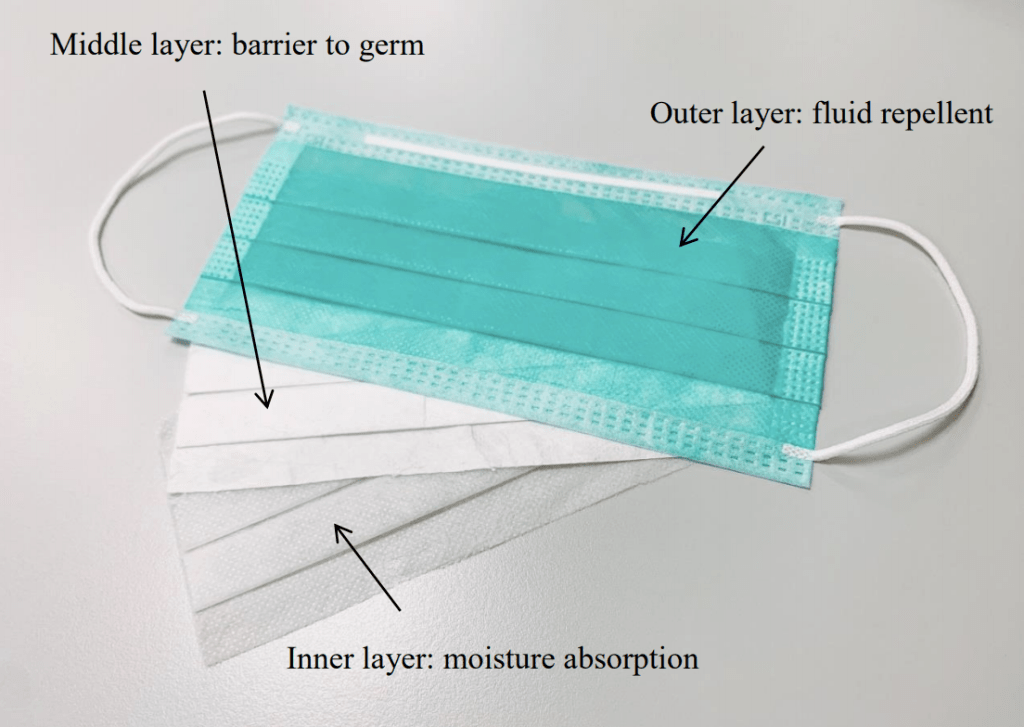
A surgical mask is typically composed of three layers. 1) Outer-layer 2) Middle-layer 3) Inner-layer. In addition, there are elastic ear loops and aluminium metal nose strip to facilitate the better fixation of mask on the face. The main function of outer layer is to provide with primary air filtration and to somehow air regulation. the middle layer serve as a filtration barrier and the inner layer should ideally provides comfort by dissipating the heat and moisture created by exhaling breath. However, in my experience this function is not achieved with a common surgical mask. Moreover the three layers have usually three folded lines to facilitate the fit of the mask and to provide maximum coverage from nose to under jaw of the wearer. When the mask is pulled down after fixing on nose, because of the these folded portions a room in the shape of a polyhedron is crated between mouth and nose which helps to mitigate the feeling of oppression. The photo below shows the components of a mask as described above.
The three layered structure of surgical masks.
Surgical Mask–How to test a Surgical Mask Before Buying and using?
To test the mask, I decided to buy some from the market and test them by myself. Obviously one cannot conduct all those laboratory testings however, I can do at least some checks before using. This is important because it is related to your health. In order to do a comparative study, I bought a good quality one and a comparatively low quality.
Mask protection level Information and packing
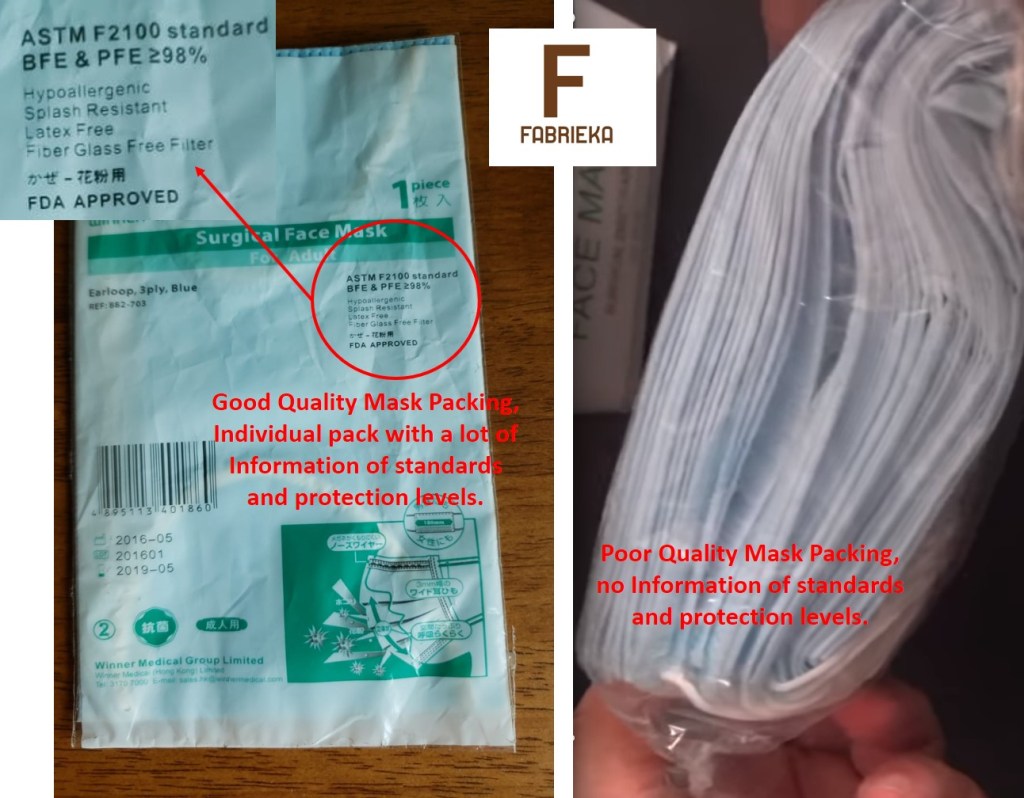
The two masks have same quantity in the box that is 50 masks in one box. However, the good quality mask has individually packed masks in a wrap with a lot of information on it as shown in the figure below. The information on the good quality mask tells about the standard to which this mask qualifies and the protection level. It also tells that the mask is hypoallergenic, latex free and fiber glass free. Hypoallergenic, meaning “below normal” or “slightly” allergenic. Latex free means the elastic ear loops are latex free ad fiberglass free means that there is no fiber glass is used in making the mask fabric which can be allergenic to some people. On top of that the information on the good quality mask also tells us about the bacterial and particle filtration efficiency of these masks. On the other hand, there is no such information available on the packing of the poor-quality mask. Therefore, while buying the mask you should check the packing of mask and must check the standards and other information as described above. Now let’s proceed towards other checks on the quality of mask.
Good quality mask and poor quality mask packing comparison; photo by fabrieka.com
2. Fit and size test
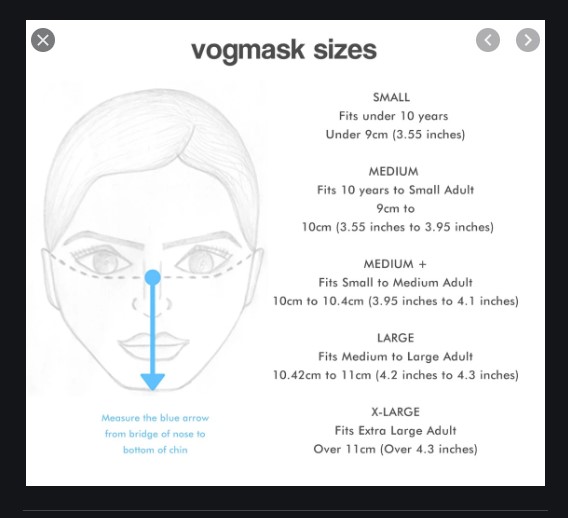
To test the fit of mask on your face the first thing you should consider is to check the size of your Nose to bottom of lower jaw bridge length and decide which size will suits you. The following figure shows how to measure your Nose to bottom of lower jaw bridge length. After knowing your size, you can check that either the mask you are going to buy fits you or not after opening of folded sections.
How to measure nose-lower jaw bridge length and different sizes of mask, photo by vogmask
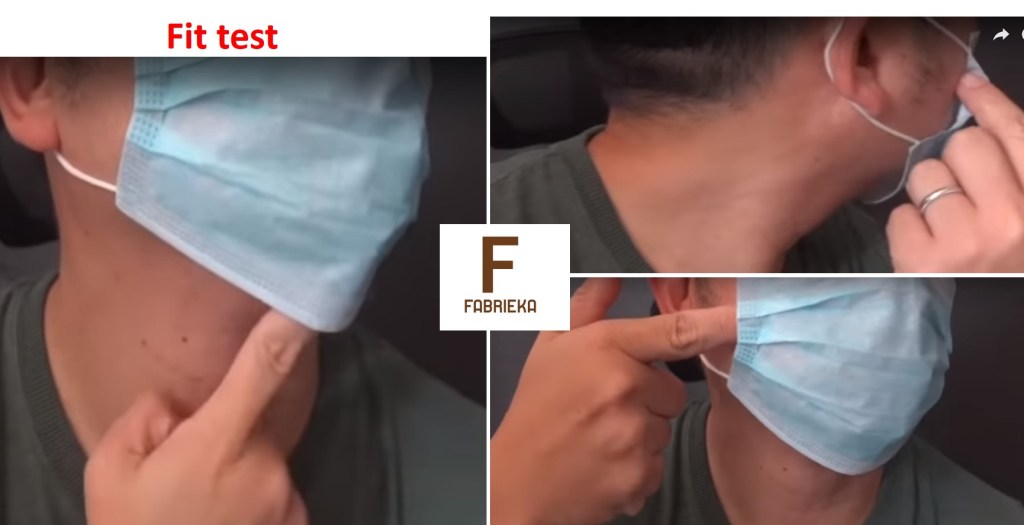
Once the size is measured, then you can put on the mask on your face and pull it downward to cover your Nose-lower jaw bridge. After covering the whole area just fix the aluminum nose wire on top of your nose such that there is no gap between top side of mask and your skin. After that check the sides of mask near your ear there should not be any gap between mask inner surface and your skin. Similarly check the area under lower jaw there should also be no gap between mask inner surface and your skin. This test means that the mask should provide complete seal from all sides and there should not be any gap that can possibly allow contaminant air to enter. If there are different sizes available in the market, then most important is choosing right size. However, if the right size also do not fit will and do not provide air tight seal from all sides on your face then the quality of mask in terms of fit is not acceptable.
Fit test of mask; photo by fabrieka.com
3. Liquid droplet penetration test
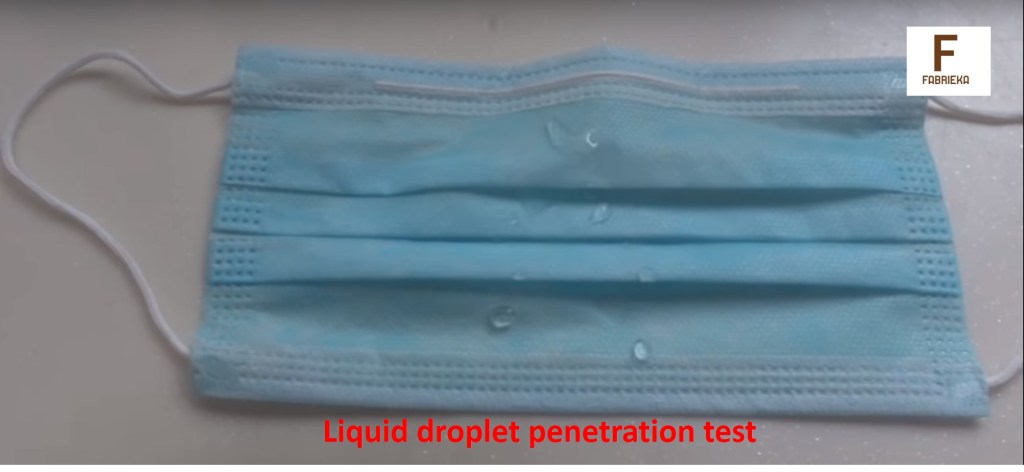
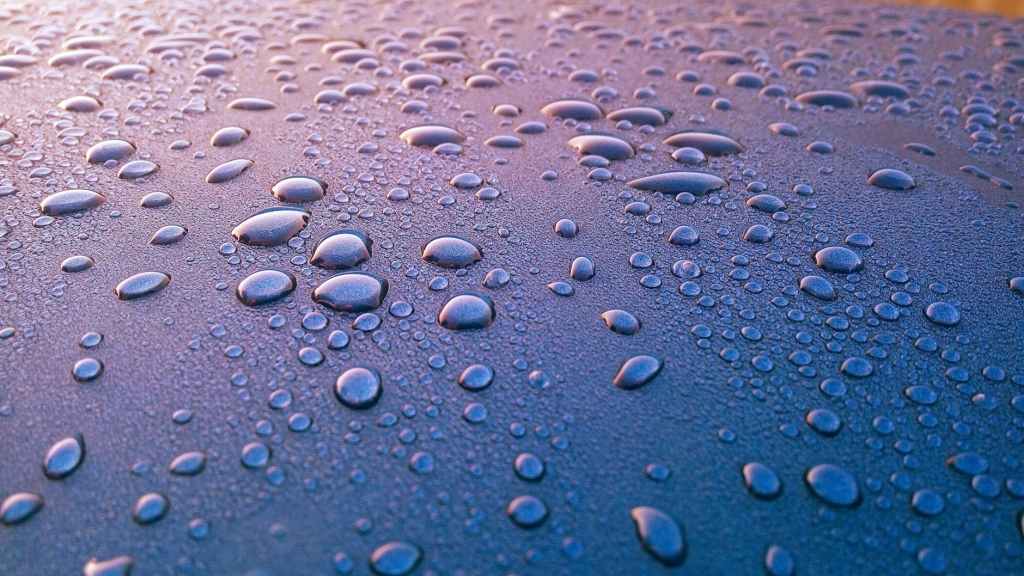
After conducting the fit test you can conduct a Liquid droplet penetration (LDP) test. This is very critical because it has been established that the novel Corona Virus travels in liquid droplets and can be transmitted via liquid droplets. When an infected person sneezes and you are nearby, the virus can transmit in the liquid droplets coming out of sneezing and chances of inhaling virus by you are very high. Therefore, among all other features this is most important and must not be compromised. To test LDP, you can just put a mask on a smooth surface with the outer layer that is mostly colored side, facing toward you. Now drop some water drops by using a dropper or just by your hand. For a mask to qualify LDP test these droplets should not penetrate into the outer layer and should stay on the surface. However, remember if you will put some pressure or try to rub the water drop they will be absorbed or penetrated into the fabric, this is something to do with the surface tension of water drop and micro structure of the fabric, which I am not going to explain because it is out of scope of this blog. What you need to know is the water droplets should not be penetrated or absorbed on their own without any rubbing or any pressure.
Liquid droplet penetration test; photo by fabrieka.com
Above is the figure of a good quality mask which I bought from the market. The poor quality mask failed the LDP test therefore, it can be stated that there are fake masks available in the market very easily. So you should be careful and must perform LDP test before using a mask especially if you are in a contagious environment where chances of inhaling virus are high.
4. Testing the three layers
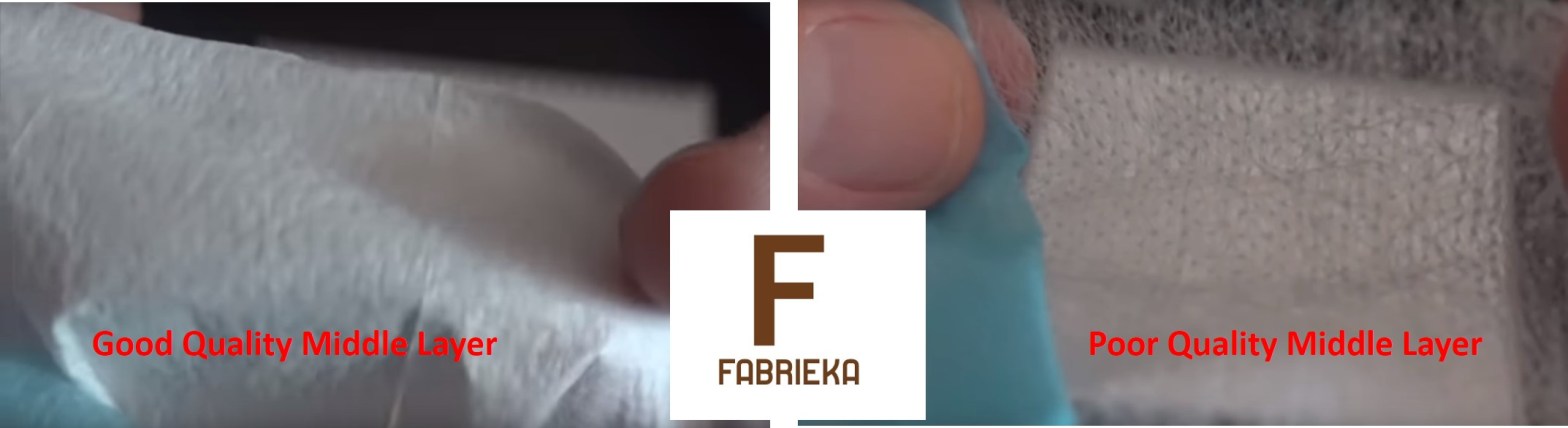
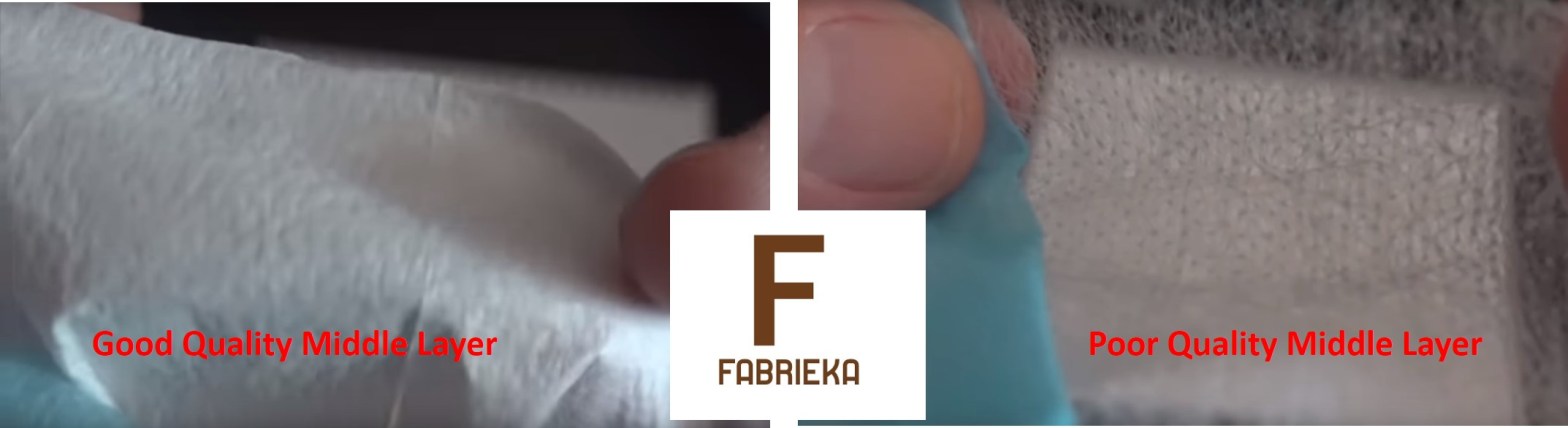
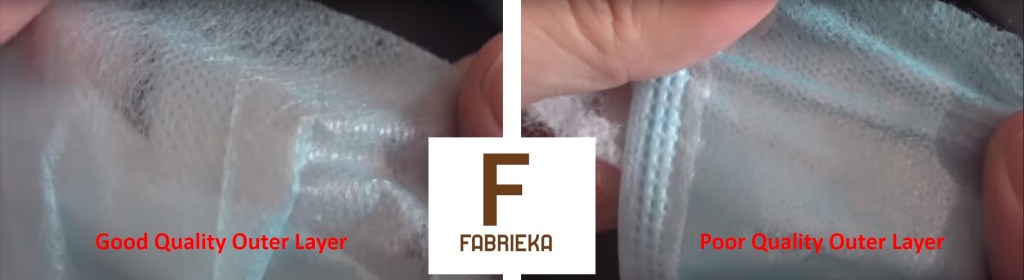
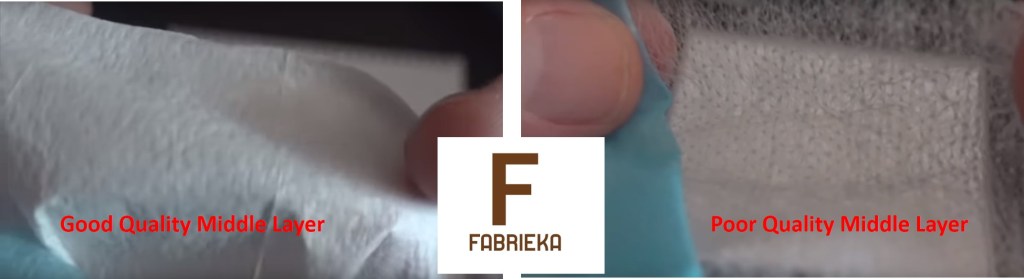
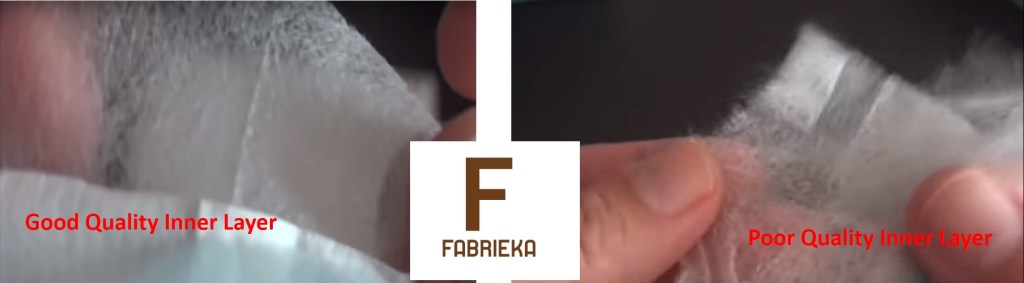
After LDP, you can test the quality of mask by observing each single layer. Generally, the outer and inner layers of a mask should be spun-bonded poly polypropylene non woven fabric having a GSM of 20-25 while, the middle layer should be melt-blown with a little higher GSM of 25-30. Obviously every person cannot know the GSM of fabric just by touching or feeling it, for this one need to have a sensitive weighing balance and need to know how to calculate the GSM of a fabric. However, you can just compare the different available qualities. Just take a paper cutting knife and cut open the three layers of both masks, then compare them layer by layer. The more poor is the quality the more transparent or see through the fabric is. A good quality has enough fiber contents per unit area and do not look like a see through or transparent fabric. Below figures show a comparison of three layers of a good quality mask and a poor quality mask which I have bought from the market for comparison. The most frightening observation which I have made is that the good quality mask has a very thick filter layer that is middle layer and the poor quality mask has a very thin or an open/see through middle layer as shown in the figure below. Surely, such a poor quality mask cannot protect you from any infection. Same was the case with other two layers.
Comparison of outer layers of a good quality and poor quality mask; photo by fabrieka.comComparison of middle layers of a good quality and poor quality mask; photo by fabrieka.comComparison of inner layers of a good quality and poor quality mask; photo by fabrieka.com
5. Strength test
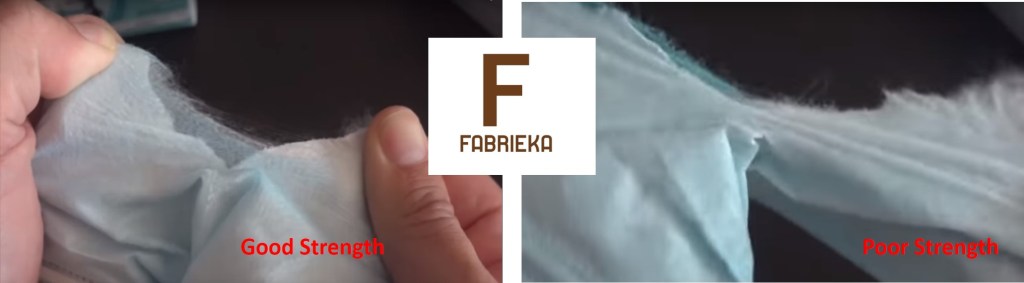
After testing all above features, you can quickly conduct a strength test of a mask, the strength of mask is not so critical as compared to the other features because it is a disposable item. However, a mask should at least have enough strength so that it can be used for 8 hours continuously that is a normal period of working hours for almost every one. To test the strength just try to tear a mask with three layers altogether. You will find it difficult to tear a good quality mask because of enough fiber contents as compared to poor quality mask with too little fiber contents as shown in the figure below.
Comparison of tear strength of a good quality and poor quality mask; photo by fabrieka.com
Corona Virus, now a days is the most scary thing every one is talking about. How it is spreading?, how to protect from it?, how to contain the spread of this virus? and Is there any cure or vaccine for it? These are the questions almost everyone is looking answers for. Being a Textile Engineer and having knowledge in the area of Medical Textiles as well as Non-woven fabrics, I thought I should give my readers a laymen knowledge about one of the protection methods, that is wearing a surgical mask. Now there are many different kinds of protective masks available, however the most common and most used one is the disposable surgical mask. So in this blog I will present surgical masks, their anatomy, function and properties according to protection levels. Because now a days everyone is looking for a mask consequently with a boost in demand, many fakes also made their space in the market. Therefore, I will also try to include the technical as well as physical details of an ideal mask so that fakes can be identified easily. So let’s start with the first question that is what is a surgical mask and why it is used?
The surgical mask that are available commonly on the market can be divided into two categories according to their shapes, i.e. flat type face mask and half-face face mask. In addition to this, face mask can also be divided into two categories according to their applications i.e. face mask for filtering particulate and face mask for filtering air. The face mask for filtering air need to be provided with porous materials, such as activated carbon. According to the properties of the porous materials, different kinds of noxious gases or organic gases can be absorbed. However, like safety helmets, face mask are effective only when they are used correctly. When people select or use the face mask, they should not only consider the filtering functions of the face mask but also the airtight property of the face mask. If the airtight property of the face mask is not good enough, people will still breathe in noxious air via chinks when they wear the face mask. Thus, face mask structures cannot protect people from breathing noxious air even though their filtering functions are perfect. The face mask for filtering particulates are usually designed to give protection to the wearer in an environment where there are chances of airborne contagious particles or bacterial contaminants in the air. Therefore, this type of mask must be very good and has high filtration efficiency. The performance of this type of mask mainly depends on two features. Firstly, the filtration efficiency or capacity, secondly the rate of air flow that is somehow related to breathability.
The structure of a surgical mask
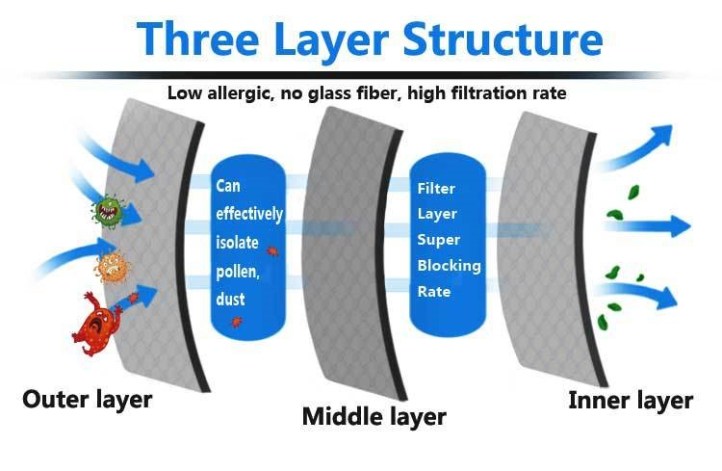
A surgical mask is typically composed of three layers. 1) Outer-layer 2) Middle-layer 3) Inner-layer. In addition, there are elastic ear loops and aluminium metal nose strip to facilitate the better fixation of mask on the face. The main function of outer layer is to provide with primary air filtration and to somehow air regulation. the middle layer serve as a filtration barrier and the inner layer should ideally provides comfort by dissipating the heat and moisture created by exhaling breath. However, in my experience this function is not achieved with a common surgical mask. Moreover the three layers have usually three folded lines to facilitate the fit of the mask and to provide maximum coverage from nose to bottom of the lower jaw of the wearer. When the mask is pulled down after fixing on nose, because of these folded portions a room in the shape of a polyhedron is crated between mouth and nose which helps to mitigate the feeling of oppression. The photo below shows the components of a mask as described above.
The three layer Mask Structure
Why surgical mask is used?
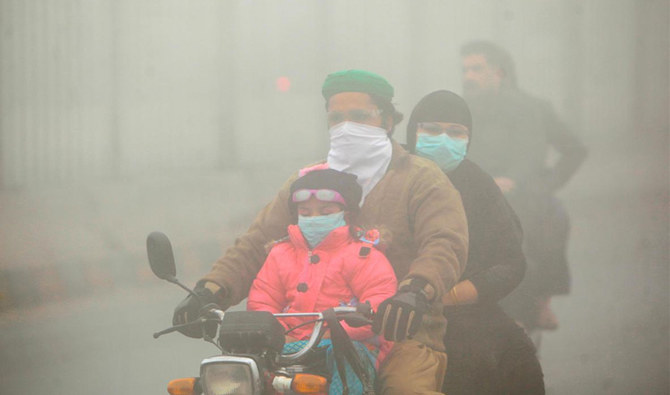
A surgical mask, also known as a procedure mask or medical mask is primarily worn by health professionals to catch the bacteria shed in liquid droplets and aerosols from the wearer’s mouth and nose. They are not designed to protect the wearer from inhaling airborne bacteria or virus particles and are less effective than respirators, such as N95 masks, which provide better protection due to their material, shape and tight seal. Among the general public of East Asian countries including, China, Japan and South Korea the use of surgical mask is very common in order to reduce the spreading of airborne diseases and to prevent the inhaling of airborne dust particles created because of air pollution. More recently, due to the rising issue of smog in south and southeast Asia, surgical masks and air filtering face masks are now frequently used in major cities in Pakistan, India, Nepal and Thailand when air quality deteriorates to toxic levels. Additionally, face masks are used in Indonesia, Malaysia and Singapore during the southeast Asian haze season. Air filtering surgical-style masks are quite popular across Asia. Therefore, many companies have released masks that prevent the breathing in of airborne dust particles.
A family in Pakistan wearing masks to protect from choking smog; photo by google.
An Ideal Surgical Mask
In order to claim a product as a surgical/medical mask, the product must pass a series of tests according to standards such as ASTM F2100 or EN14683. For ASTM F2100, the performance of a surgical/medical mask is based on the tests for (1) bacterial filtration efficiency (BFE), (2) differential pressure, (3) sub-micron particulate filtration efficiency (PFE), (4) resistance to penetration tested by synthetic blood, and (5) resistance to flammability. The figure below shows the surgical/medical mask requirements by performance level according to the ASTM F2100.
Mask size
Usually the masks are available in the market in two sizes that are adult and children size. However, the size of a mask can be Small, Medium, Medium+ , Large and Extra large. The size of a mask is mainly dependent on the length of the nose-bottom of lower jaw bridge as shown in the figure below. Therefore, by measuring your nose-bottom of lower jaw bridge you can easily identify that which mask size is ideal for your face. Remember to buy the correct size because it is important in terms of air tight protection from sides of the mask.
Sizes of mask; photo by vogmask.
Does a Surgical mask protect from Corona Virus?
The answer is a big NO. A surgical mask is composed of a filtering barrier made of a spun-bond non-woven fabric. This is the most important component of a mask and it also determines the protection level of the mask. The filtration efficiency largely depends on the particle size and rate of airflow for the same filtering layer. Generally, it is relatively ineffective for a filtering barrier used in a conventional protective mask to filter out particles having sizes at around 0.3µm and it is even more difficult to filter out particles when the rate of airflow is high. Most filtering barrier layers of conventional protective masks are not treated with anti-bacterial or anti-viral finishes. Therefore, these protective masks simply serve only as a physical barrier to filter out contaminants. When it comes to viruses and bacteria, these filtration layers cannot kill them during filtration that should be the ideal and most desirable function of an anti-bacterial and anti-viral masks. For typical surgical/medical masks, and in reference to the BFE test and the sub-micron PFE test, the filtration efficiency percentage must not be lower than 95%. The average size of the aerosol particle in BFE test is around 3µm while the average size of the aerosol particle in the sub-micron PFE test is around 0.1µm. The aerosol particles are trapped by protective masks comprising nonwoven meshes of fibers through a combination of mechanisms including inertial impaction capture, interception capture, and Brownian diffusion capture. Inertial impaction /interception predominates in the BFE test because of the relatively large particle size while Brownian diffusion predominates in the sub-micron PFE test because of the relatively small particle size. The most penetrating particle size (MPPS) is 0.3µm. As both diffusion and impaction/interception are inefficient for particles near the MPPS, passing the tests (i.e., BFE test and sub-micron PFE test) does not justify the high level of protection of the surgical/medical mask. Moreover, surgical/medical masks are not designed to seal tightly to the face. Without an adequate seal to the face, inhaled breath is not forced through the filter but instead flows through the gaps around the seal area, providing little protection by allowing potentially hazardous contaminants to enter a wearer’s breathing zone through gaps between his face and the mask. Therefore, surgical/medical masks do not provide the degree of protection as required for respiratory personal protective equipment (PPE) by the Food and Drug Administration (FDA).
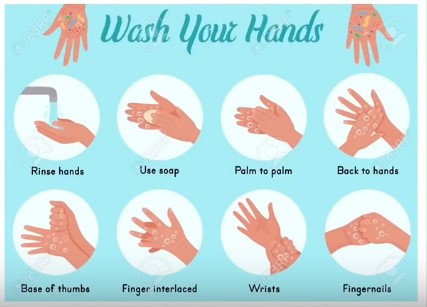
Washing your hands can be more helpful than wearing a mask.
The result of any activity primarily depends upon the easiness or comfort with which it is performed. If the comfort level is high the efficiency of the activity will become high producing best results. Since textiles structures especially for clothing, are in constant contact with the human. Therefore, the success of any activity is affected by the comfort offered by the fabric structure worn by them. In this blog some of the main features of textile structures which distinguish them from traditional engineering material and make them a prime choice especially for clothing applications are listed and explained.
Main features of textile structures
Resilience and Flexibility
The ability of a material to recover its original shape and size after removal of strain which caused the deformation is known as resilience. Textile structures are visco-elastic in nature and due to this unique feature of visco-elasticity they are resilient and flexible. Unlike traditional engineering materials (TEMs), textile structures are highly resilient and they can spring back to their original state after being crushed or wrinkled. Resilience is also termed as memory. Resilience is a vivid characteristic of most textile structures and it can be expressed as:
Resilience can also be defined as a measure of elastic reversibility. The creep and relaxation properties of both textile fibers and fabrics are directly related to resilience. Primary creep that is recoverable deformation is a function of delayed elasticity which is also an important factor in resilience. While, the secondary creep that is permanent deformation is a measure of elastic irreversibility.
Advantage of resilience
Being resilient, textile structures offer moderate resistance to deforming force and spring back on removal of strain while producing only shallow wrinkles which finally disappear. In case of textile structures like fabrics for clothing the rates of strain and retraction are usually low but the cyclic deformation is significant. Meanwhile, clothing is not worn continuously and there is a definite rest period between cyclic deformations or between series of cycles. Therefore, the secondary creep is not too much important and baggy knees and wrinkled sleeves do occur but they can be removed by proper deformation at high temperatures and moisture contents. Therefore in case of clothing resilience controls secondary creep or delayed recovery, feel and the appearance of the fabric. Whereas, In case of textile structures like fabrics for upholstery applications the rate of strain is slow and takes place under dead load therefore the secondary creep is more important. In case of textile structures like pile fabrics for carpet application, the structure undergoes two kinds of stresses the impact stress which is caused by the walking on it and the constant stress caused of long duration due to furniture. The impact stress requires rapid recovery that is achieved due to the feature of resilience.
2. Formability
Textile structures have good formability as compared to TEM’s. The formability of a textile structure i.e. a fabric can be defined as the maximum compression a fabric can take up in the plane in a certain direction before it buckles. The formability can be expressed as the product of an anisotropy ratio and the square of the fabric thickness. The formability of a fabric determines its tailor ability and the crease pattern. The formability is dependent on fabric direction, and the integrated formability is related to the product of buckling load and shear angle.
Advantage of formability
In case of garment manufacturing formability is the key feature for raw material. Formability is actually a term used by the tailor to express ease of making up the garment. Due to their good formability textile structures can be tailored in to various shapes very easily. Unlike TEM’s textile structures can be bent, twisted, cut into different shapes and patterns with much less energy. For example woven fabrics can undergo large strains even at low stresses due to the straightening of the crimped constituent yarns within the fabric and can be deformed into shapes. This feature makes textile structures the premier and only candidate for clothing needs of humans.
3. Viscoelasticity
Viscoelastic materials exhibit both viscous and elastic characteristics when they undergo deformation. They resist shear flow and strain linearly when stress is applied. They have a time dependent or frequency dependent stress and strain relationship. The slope of stress vs. strain plot depends on strain rate. Elastic materials undergo strain when stretched and quickly return to their original state when the stress is removed. While, viscoelastic materials have both of these properties. They have a unique equilibrium structure and ultimately recover fully after removal of a momentary load. Textile structures have this unique feature of viscoelasticity. After being squeezed they return to their original shape when given enough time for recovery.
Advantage of viscoelasticity
Unlike purely elastic materials, textile structures own a viscoelastic feature and have an elastic component as well as a viscous component. Elastic materials do not dissipate energy on removal of applied load. Conversely, textile structures being viscoelastic loses energy. Hysteresis is always observed in the stress strain curve. The area of the loop is equal to the energy lost during the loading cycle. In reality, viscoelasticity is a molecular rearrangement. In case of textile structures like yarns or fabric this phenomenon can be explained by the fact that when a stress is applied to them, the unit cells or fibers in the structure will slip and rearrange themselves. This movement or rearrangement is called creep. A back stress will be created in the structure. When the magnitude of the back stress and applied stress becomes equal then the structure will no longer creeps. On the removal of applied stress the accumulated back stresses will cause the fibers to return to their original arrangement with loss in the energy. Therefore, this behavior makes textile structures a potential candidate for application where energy dissipation is required at a certain level like, energy dissipation during an impact event.
4. Porosity and Breathability
Most of the textile structures like yarns and fabrics are highly porous and breathable materials. For example every piece of woven fabric is an integration of warp yarns and weft yarns through intersection. The extent of this intersection is largely dependent on the friction between fibers and yarns together with fibre entanglement, while the distance between two parallel adjacent yarns determines the porosity of a fabric structure. The existence of such a discrete porous structure is a key feature of textile structures which distinguishes them from a continuum engineering structure such as a metal sheet.
Advantage of porosity and breathability
Porosity and breathability of textile structures as clothing material have a dominant influence on the performance characteristics of a material, particularly in controlling transport of fluids. The suitability of a particular fabric structure for clothing applications depends on its ability to maintain the thermal equilibrium of the wearer together with resistance to transmission of heat and moisture. The fiber type and the fabric structure both influence the moisture transmission characteristics of the fabric. Though, the fibers do not transmit an appreciable amount of moisture. The moisture transmission through the fabric occurs only through the void spaces or pores within the fabric that is the portion unoccupied by fibers and is purely a structural feature. Therefore, higher air permeability of textile structures or porosity is advantageous in applications where better moisture transmission is aimed.
5. Thermophysiological properties and Moisture management
Thermo-physiological comfort includes properties related to moisture and thermal management. It is the garment’s ability to keep the wearer dry and to regulate body temperature during a change in the environmental temperature or humidity and during physical activity therefore contributing to the thermal equilibrium of the body. Thermo-physiological comfort mainly lies in moisture management of the textile structure of clothing material, which often refers to the transport of both moisture vapor and liquid away from the body. Moisture management of textile structures is mainly influenced by the thermal properties of those structures. Natural textile fibers like cotton, wool, and silk provide unique moisture management properties which are directly related to their structures and provide comfort. Comfort can be defined as a pleasant state of psychological, physiological and physical harmony between a human being and the environment. That is why instead of the some promising properties of most of the synthetic textile structures they are not preferred for clothing application because of their hydrophobic nature which provides less comfort to the wearer compared to the natural fabrics. For a person engaged in normal routine indoor activity the metabolic heat generated (which increases six times with 14 times more perspiration during sporting activity) should be dissipated readily through the clothing as sweat. Therefore an important feature of any textile structure is how it transports the sweat water out of the body surface in order to make the wearer feel comfortable.
Advantage of Thermophysiological properties and moisture management
Textile structure as clothing material plays a vital role in thermo-regulatory process as it alters heat loss from the skin and also changes the moisture loss from skin. In the case of clothing, temperature is not a vital factor, both because of the thermo-stating effect of the human body and the inability of humans to remain alive except within a limited range of temperatures. However, moisture content is a very important factor. When the external climatic conditions outmatch the body requirements some specific textile material can be used to provide the optimum body demands for better comfort feelings due to their unique structure. Therefore, the type of garment and the climate for which it is intended to use must be taken into consideration.
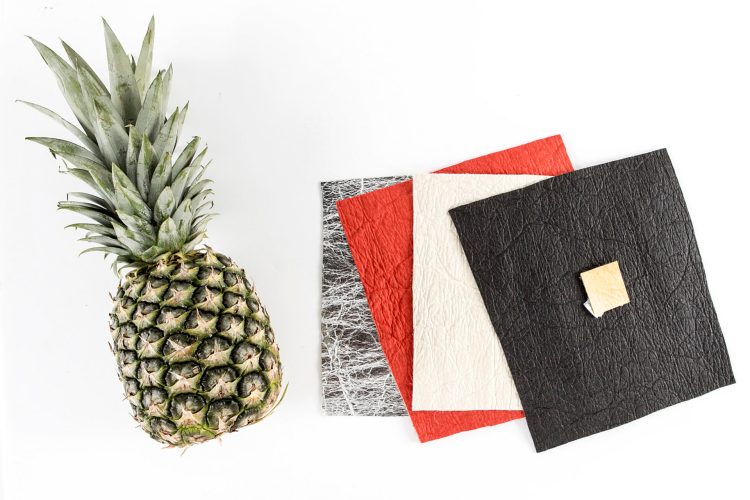
The pineapple is an herbaceous perennial monocotyledonous plant. The leaves of pineapple involve the stem and shoots. Adult plants hold up to 80 leaves which vary in shape having length of up to 1.3 meters. They are rigid with waxes in the upper and lower surfaces which reduce perspiration. At the base of the stem older leaves are located having a spear format. The younger leaves are elongated conserving a wider baseline. The pineapple leaf fibers (PALFs) are strong, white and silky fibers extracted from the leaves of pineapple plant.Like other natural fibers PALFs are cellulosic fibers. The composition of PALFs is show in table1. There exist ester linkages between the hemicellulose and the lignin in the fibers. PALFs also contain other minor constituents such as uronic anhydride, pentosan and certain inorganic substances. The length of PALF fibre ranges from 3–8mm, diameter 7–18 μm, ultimate tensile elongation 3.42%, initial tensile modulus 10.2 CN/tex and density 1.543 g/cm 3. On average, about 22 units of pineapple leaf weigh a kilogram. The reported fiber yield is about 2.7 to 3.5% of fibers. The extraction of 100 kg of leaves yielded 3.5 to 4 kg of the PALFs by the process of shredding. The acid coupled steam treatment could be employed before processing the fibers in order to extract nanofibrils. The steam explosion process resulted in the isolation of PALF nanofibers having a width in the range of 5–60 nm. The high-pressure defibrillation gives a unique morphology of the interconnected web-like structure of nanofibers.
Pineapple leaf fibers after extraction
PALFs fibre composition
Cellulose 67.12-82%
Hemi-cellulose 9.45-18.80%
Hollow-cellulose 80-87.5%
Lignin 4.4-15.4%
Pectin 1.2-3%
Fat and wax 3.2-4.2%
Ash 0.9-2.7%
Yarn made of Pineapple fiber
Properties of PALFs Fibers
Among the various types of natural fibers, PALFs exhibits excellent mechanical properties. The superior mechanical properties of PALFs are associated with their structure due to high cellulose content and low microfibril angle. The fiber properties vary according to their dimensional appearance, length diameter, planting conditions, age and type of leaves. The PALFs are one of the best in terms of fineness indexes among vegetal fibers, which make them suitable for many industrial applications. Due to low lignin content, high fineness index and high aspect ratio PALFs have great potential for many applications. When PALFs like other natural fibers are transformed into nanocellulose, all of their potential defects due to extraction are removed and fibers with very high specific modulus could be obtained. PALFs have poor adhesion properties.
Processing of fiber
PALFs fibers could not be blended either with cotton or with synthetic fibers due to their long length and high fibre weight. In order to impart hydrophobicity, mechanical strength and chemical inertness the PALFs before processing are required to be surface treated. For example, the graft copolymerization onto PALFs could be employed for physicochemical modification and improvement of the textile performance of fibers. As PALFs has poor adhesion properties due to its structure, in order to use this fibre as reinforcement for composite surface adhesion properties must be improved. The treatment with NaOH with the use of coupling agent poly (styrene- co -maleic anhydride) gives better adhesion with the matrix of high impact polystyrene (HIPS) and tensile strength for the composites increases.
Performance of fiber
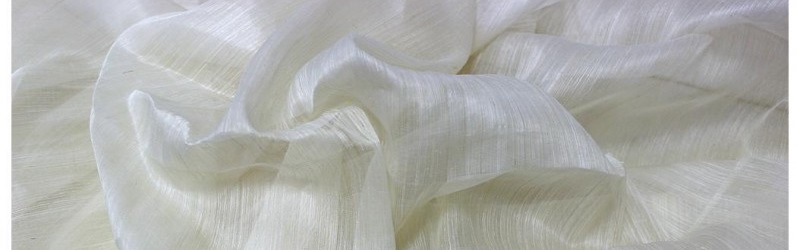
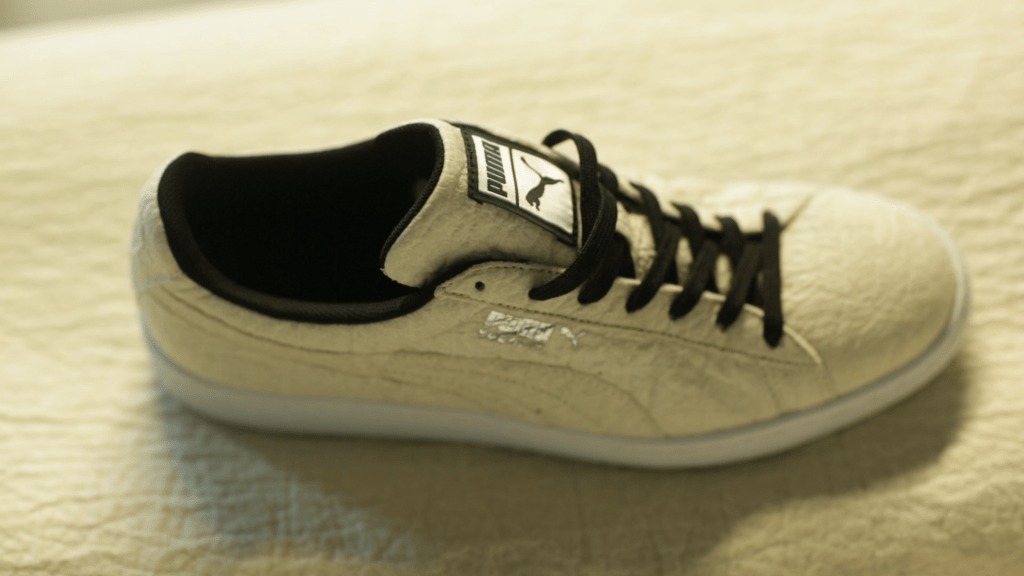
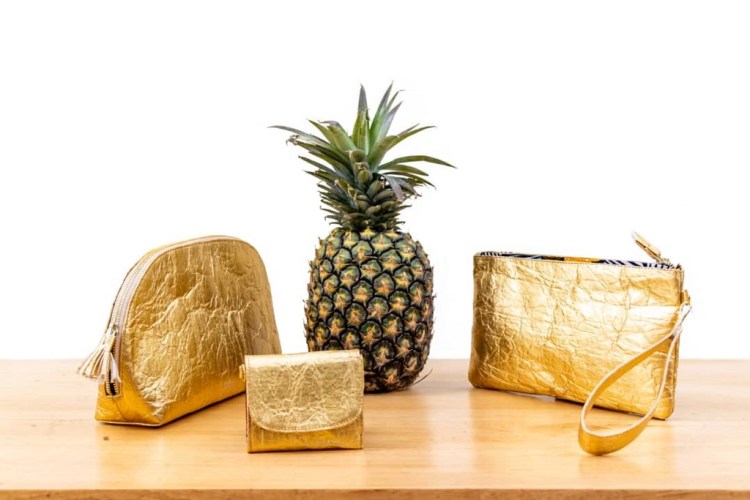
The superior mechanical properties of PALFs associated with their structure due to high cellulose content and low micro-fibril angle makes them one of the strongest fibers among natural fibers. PALFs derived nano-cellulose can be used to make nano-composites. PALFs nano-sized cellulose fibrils in the polyurethane matrix, especially for medical implants give high tensile strength and high strain to failure with strongly improved modulus. For example, nano-cellulose polyurethane vascular grafts with a wall thickness of 0.7–1.0 mm showed elongation at a break of 800–1200%, and withstood hydraulic pressures up to 300 kPa. The produced nano-cellulose and its composites have a wide range of medical applications including cardiovascular implants, scaffolds for tissue engineering, repair of articular cartilage, vascular grafts, urethral catheters, mammary prostheses, penile prostheses, adhesion barriers and artificial skin. Strong and sustainable textiles can also be produced from PALFs. One such example is Pinatex that can be used in everything from bags to furniture. Even shoe companies like Puma and Camper have made prototypes with the textile of PALFs as an alternative to leather.
Pineapple silk fabric made of Pineapple fiberPuma Shoes made of Pineapple leatherBags made of Pineapple leather
Trim or trimming in fashion clothing is a form of applied ornament, such as ribbon, ruffles, belts or narrow bands and linings. Such trims once were a characteristic of mid-Victorian fashion. Historically, all trim were made and applied by hand, which made heavily trimmed furnishings and garments expensive and high-rank as shown in figure 1. After industrial revolution, machines such as machines for woven trims and sewing machines make these trimmings cheaper and affordable for modest dressmakers and home sewers. Therefore, modern fashion evolved emphasizing delicacy of cut and construction over impenetrability of trimming making the applied trims a signifier of mass produced clothing by the 1930s. The iconic braid and gold button trim of the Chanel suit are a notable survival of trim in high fashion of modern times.Today, most trimmings are commercially manufactured. Scalamandré is known for elaborate trim for home furnishings, and Wrights is a leading manufacturer of trim for home sewing and crafts. Trims are used generally to enhance the beauty of the garments. It attracts buyers. Appropriate use of it creates more value of the product. Some ancient weaving and braiding techniques were used in the past to produce decorative and fashion trims. Such techniques include inkle weaving, card or tablet weaving and ancient Japanese braiding technique names as Kumihimo. This blog provides an insight of these ancient techniques to produce fashion trims for today’s fashion clothing.
Figure 1. Elaborately trimmed fashions for April 1861 from Godey’s Lady’s Book.
Inkle weaving
Inkle weaving produces a type of weave that belongs to the “bound weave” category of fabrics. Inkle weaving typically produces what is known as “warp-faced” bands. That is, only the warp threads, the length-wise threads, show in the final woven piece. The weft threads are completely hidden by the warp, except at the very edges. The term “Inkle” simply means “ribbon” or “tape”. Inkle weaving is commonly used for narrow work such as trims, straps and belts. Inkle weaving was referred to in Shakespeare’s Love’s Labour’s Lost. It was brought to the United States in the 1930s, but predates this by many centuries in other countries.
Inkle Loom
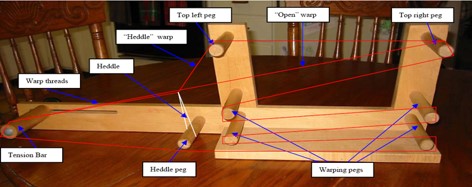
Inkle looms are constructed in both floor and table-top models. Either model is characterized by a wooden framework upon which dowels have been fastened. These dowels will hold the warp threads when the loom has been dressed. One of the dowels, or a paddle, is constructed so that its position can be adjusted. This tensioning device will be taken in as weaving commences and the warp threads become shorter. Additional equipment includes yarn of the weaver’s choice, yarn or thread for forming heddles and a shuttle to hold the weft. One such model of inkle loom is shown in figure 2. The shed is created by manually raising or lowering the warp yarns, some of which are held in place by fixed heddles on a loom known as an inkle loom. The inkle loom is threaded with warp threads according to the weaver’s design, alternating between yarn that can be raised and lowered and yarn that is secured in place through the use of the heddles.
Figure 2. A simple model of an Inkle loom
Weaving on Inkle loom
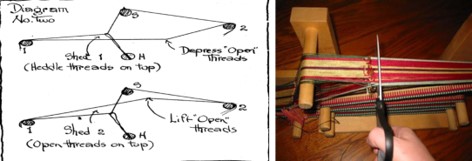
The raising and lowering of these warp threads creates the shed through which the weft thread will be carried on a shuttle as shown in figure 3. The weaver should make one pass with the shuttle with each opening of a shed through the lifting and lowering of threads. A simple lifting and lowering of threads creates a plain-weave in which warp threads are slightly offset. Weft threads are only visible at the edges of the band and the weaver may wish to take this into account by warping threads that will form the edges in the same color as the weft. As the weaving commences, the warp threads will shorten on the loom and the weaver will need to adjust the tension periodically. As the inkle band progresses, it will also get closer to the heddles. The weaver will also need to advance the warp thread along the bottom of the loom to open up new weaving space. When the warp is ready to be advanced the tension should be loosened and tightened again in order to resume the weaving process.
Figure 3. Shed formation on the inkle loom
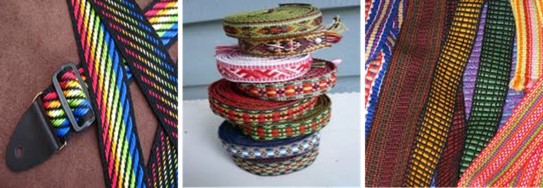
There are other more advanced techniques in which, instead of merely allowing warp threads to alternate in their up or down positions, individual threads are brought to the surface to form what is called a “pick up” pattern. One side of the band will show the exposed surfaces of warp threads while, on the other side of the pattern, the weft thread will be visible. Using a supplemental weft thread that will come up over the top of certain warp threads, brocaded designs can also be created into the inkle band. Inkle bands are quite strong and can be used in applications including, guitar, camera straps, narrow bands and colorful shoelaces. In fashion the use of inkle bands can be found as belts and trims for garments and other textiles as shown in figure 4.
Figure 4. Belts and color full trims for fashion garments made on inkle loom
Card and tablet weaving
Card or tablet weaving is a method of weaving strong, narrow, decorative bands. The equipment required is very cheap and simple, yet the range of possible patterns is immense. Tablet woven bands are known to have been made in Europe from the Bronze Age up until medieval times, and they are still made in parts of the world such as Turkey and Pakistan. Uses of tablet-woven bands included the decoration of clothing, and use as belts and straps. An inkle loom is also useful in the practice of tablet weaving for its added portability. Simply thread the warp onto the loom but use cards instead of alternating between free-hanging and heddle-secured yarn.
Preparing card or tablets and yarns
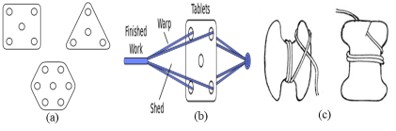
Card or tablets can be made of cardboard or playing cards. To make a card or tablet, cut out a square about 5 cm on each side, and punch four or more holes depending on the required pattern to be waved in the corners, make the corners round as shown in Figure 5(a). Card or tablets can also be made of wood and leather. In order to make a simple band one only one card is enough however, up to eight cards can be used. Historically, the thread materials used include wool, linen, silk, and gold and silver thread.
Figure 5. (a) Cards or tablet made of cardboard or playing card (b) threading of tablet (c) shuttle
However, any kind of yarn can be used, but a thick thread about the weight of double knitting wool will be easier to work with than a very fine thread. Although fluffy knitting wool is easy to obtain, it’s hard work to weave because it sticks to itself and is very stretchy. A smoother yarn such as worsted spun wool, machine knitting wool, cotton or silk will be much easier to weave. Many colors can be achieved by using natural dyes. The weft thread is wounded onto a shuttle so that it can easily be passed through the band during weaving. The shuttle is usually about two inches in length and can be made of wood or cardboard as shown in the figure 5(c).
Threading in of card or tablet
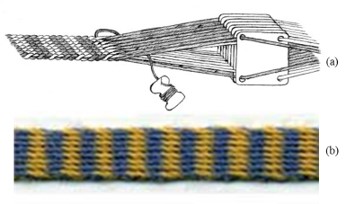
In order to make a band with eight cards and two colors of threads using a four hole card, a total of 16 lengths, about 6 foot long of each color thread are required. These are called warp threads and will run along the length of the band to be weaved. Each warp thread is then threaded through one of the holes in a tablet, in such a way that the two threads of the same color are threaded in adjacent holes. The 8 tablets lie side by side in a deck as shown in the figure 6(a). The threads are then fastened between two fixed points about 5 feet apart, so that they are horizontal and moderately stretched. The tablet will tend to turn sideways so that it lies along the threads, which is fine. When the tablet is rotated, it will twist the four warp threads into a cord, and different colors appear in alternate along its length, like a barber’s pole as shown in the figure 6(a).
Weaving by using card or tablet
The gap between the top two threads and the bottom two on each tablet is called the shed. By passing a weft thread through the shed each time by turning the tablet, eight separate cords will be locked together to make a sturdy patterned band. Turning the 8 tablets, all together, a quarter turn, will create a new shed. The tablets should not be held too tightly and a little space between them helps the threads to turn more easily. The weft threads are pushed towards the beginning of the band with the help of hand or a comb, so that the weft is pushed back as far as possible and the band will be firm and tight. This is called beating. The shed can be made clear by sliding the tablets to and fro along the warps. Pass the weft back through the new shed.
Figure 6. Using 8 Tablets to Weave a Band
The weaving is continued, like this and an even and compact band is produced with alternate horizontal stripes on the band as shown in figure 6(b).
Making diagonal and mixed patterns by using card or tablet
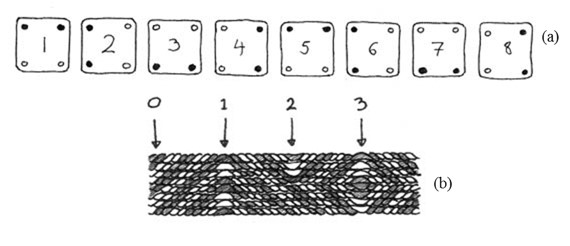
Card or tablet can be flipped about a vertical axis so that the warp threads enter the tablet from either the left or the right. If the tablet lies so that the thread follows the diagonal of the letter S, it is said to be “S threaded” and if the thread follows the diagonal of the letter Z, this is called “Z threaded”. If the tablet is flipped and then weaving continued, it will twist its warp threads in the opposite direction. This will change the way the threads lie on the surface of the band, and will also reverse the order in which the different warp threads come to the surface. This phenomenon can be used not only to untwist the warp threads, which will become twisted beyond the tablets as weaving continues, but also to create diagonal patterns on band as shown in the figure 7.
Figure 7. (a) How to orient the tablets for diagonal stripes (b) diagonal patterns
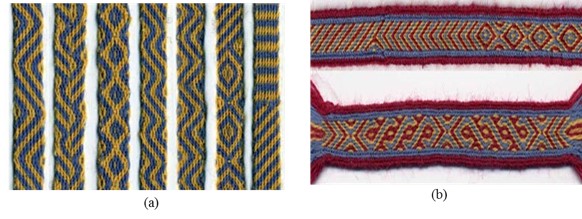
As the weaving continues, diagonal stripes of two colors of thread, appears on band surface as shown between points 0 and 1 in figure 7(b). If the lines are broken rather than sharp and clear, turn the band over and the lines will be clear and sharp on the other side. Alternatively the tablets can be rearranged in order to make the spiral runs in the opposite direction. When the point marked 1 in figure 7(b) is reached, flip all the tablets about their vertical axis, so that they are threaded in the opposite direction, and continue weaving; the diagonal lines will reverse their direction. At the point marked 2, flip the left hand four tablets, but leave the right hand four as they were. As the weaving continues a chevron pattern is formed. At the point marked 3, flip all the tablets and continue weaving, this will create a diamond pattern. Therefore, by flipping some or all of the tablets at intervals along your band, you can create almost any pattern of diagonal lines, including stripes, chevrons and diamonds. The figure 8(a) illustrates chevrons, diamonds and some other patterns which can be woven by flipping the tablets during course of weaving.
Figure 8. (a) Various patterns formed by flipping card or tablet about vertical axis (b) three color band with border
The band will be twisted if weaving is carried out with all the tablets oriented the same way (e.g. diagonal lines). In order to make a belt the twisting of band can be avoided either by having half the tablets Z-threaded and half S-threaded (e.g. chevrons and diamonds) or by flipping them all at intervals (e.g. zigzags). Three or more colors can be used provided that all the tablets are threaded same as each other and all are threaded in the same direction to start with (either S or Z). In addition, more than eight cards or tablets can be used to make a wider band with more pattern possibilities, although twenty or thirty tablets begin to be tricky to manipulate. In order to keep the edges firm border can also be added on each side of the band by threading one or two tablets with the same color in all four holes for each border. It is noteworthy that the border cards or tablet do not need to be flipped unless border warp threads have become very twisted. Figure 8 (b) shows a band created by threading each tablet with red, yellow, blue, yellow. The tablets are then arranged to weave diagonal lines as before. The borders comprise two tablets threaded entirely with blue on each edge of the band, and then another two on each side threaded entirely with red. Each pair of border tablets is arranged with one S, and one Z threaded, in order to create a flatter band. When the weaving is finished, sew the free end of the weft into the band and cut it off. The warp threads can be cut and left long enough to braid or knot in order to leave a fringe or tassels, or it can be cut short and the end of the band can be turned to sew it like a hem.
Kumihimo braiding technique
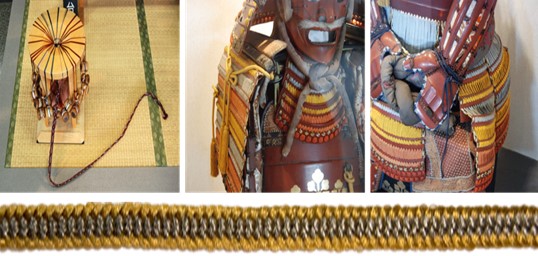
Kumihimo is an ancient Japanese technique of making trims and braids. Kumihimo is the general name for a variety of Japanese techniques which date from around 550 C.E. The braids created by Japanese craftsmen served both ornamental and essential purposes, providing a means to fasten and decorate clothing; wrap knives & swords; hang banners, mirrors, and musical instruments; bundle carrying and storage wrappings and more. They were also an integral part of the unique Samurai armor, which was constructed of numerous plates laced together with braids to form a protective covering. The different types of “narrow wares” braids, bands, cords, ropes, etc. are as numerous as the cultures which have been fashioning them for centuries, using techniques as simple as finger braiding and twisting and as complex as modern textile machinery. The construction methods were carefully guarded secrets, passed from master to apprentice through the ages.
Figure 9. The Kumihimo braiding and ancient samurai armor
The Diversity of Kumihimo Braids
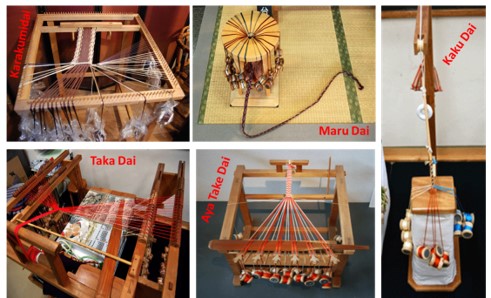
The five stands as shown in figure 10, allow the production of an amazing collection of different braided structures. The maru dai can be used to create braids that are round, square, rectangular, hollow, spiral, flat, triangular and even pentagonal and half-round in cross section. Threads are held taut between weighted tama which hang from the outer edge of the kagami (mirror), and the counterweight underneath. The braid grows downward through the sloped hole in the center. In contrast, the braid grows upward on the kaku dai, where the completed portion of the braid is suspended above the tama, which are rotated to maintain the twist in the elements themselves.
Figure 10. The five stands of Kumihimo braiding technique
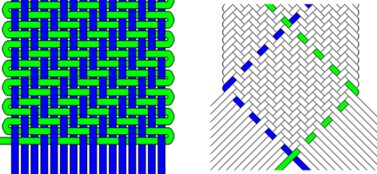
The karakumidai braid is strictly a twined structure, and great skill and patience is required to achieve the correct tension throughout the braid. The aya take dai is the only one of the stands to use a true weft, which is passed through sheds created by moving the tama from notch to notch on the wooden “feathers” at the front of the stand. Taka dai braiding process is very similar to weaving, with one key difference: each element in the braid acts as both warp and weft in turn. Because the stress on the completed braid is borne by every element within the structure, it can be far stronger than a similar fabric with warp and weft. The illustration in the figure 11 shows the path of the weft (green thread) through the warp (blue threads) in a traditional under two, over two twill fabric. Once the weft reaches the opposite edge of the warp, it returns with the same sequence, offset by one thread to create the weave. The same under two, over two sequences is used on the taka dai, but the braid is worked from the outer edge to the center. Once the thread has completed its turn as “weft”, it takes its place at the end of the row on the opposite side of the taka dai to resume the role of a warp element, as seen in the illustration on the right.
Figure 11. fabric making on Taka dai braiding
The range of structures along with the opportunities for varying fiber type, element size, element color and color placement offer a tremendous diversity of braids for the Kumihimo enthusiast. It is this vast array of possibility that makes Kumihimo such an exciting art.























 AUXETICO ADVANCED TECHNOLOGIES